What a pergola is and what bamboo adds
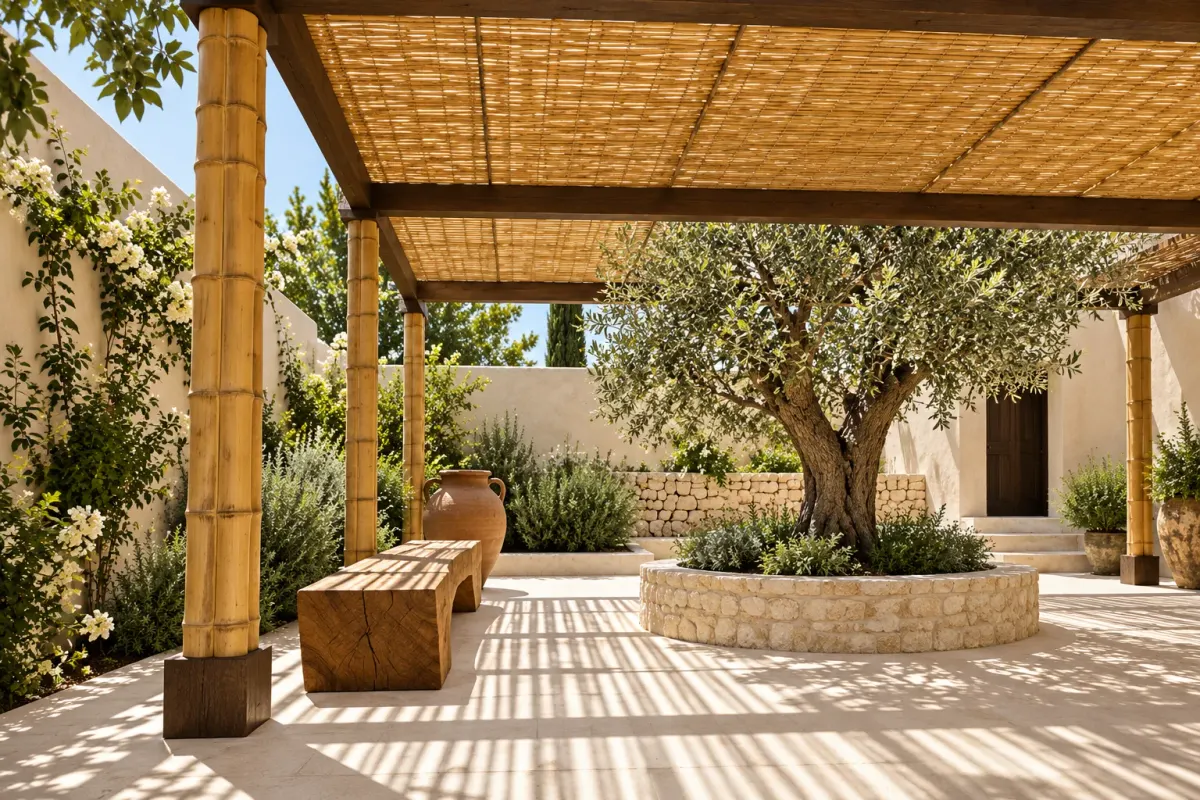
A pergola is a shade structure whose top is left partly open. Built in bamboo, it gains a distinct architectural character from its linear lines and the rhythm of its nodes. The shade is not hard and closed but filtered and linear.
The image on the bamboo pergola page shows this character. The bamboo spacing and the shading layer are designed according to how open the space should feel.
Element spacing and diameter
As the distance between elements narrows the shade deepens; as it widens more light comes through. As the sun moves during the day, the lines of shade move too, and this movement brings life to the space.
Bamboo diameter affects both the look and the load behavior. Thicker diameters give a stronger architectural line, thinner ones a lighter result. Diameter and span ratio are considered together with the supporting system.
The shading layer
An open pergola made only of bamboo elements filters light but does not give full shade. When more shade is wanted, a second layer can be added, for example closely spaced thin bamboo, woven mat or another natural cover.
This layer also increases the wind-catching surface. The shading choice and the structural solution are therefore not decided independently.
Sun direction and change through the day
Pergola shade draws different lines through the day depending on the direction of the sun. Placing the elements along an east-west or north-south axis changes when the shade deepens. For this reason pergola orientation should be considered together with the hours when the seating area is used.
Trees, neighboring buildings and tall elements nearby also affect shade. Marking the approximate path of the sun on a site sketch makes it easier to see which part needs shade at which hour. This simple exercise ties spacing and shading-layer decisions to the real need.
The relationship of the pergola with the ground and existing structures is part of the design too. The position of the columns affects seating layout and service routes. For this reason column placement should be drawn not only by structural calculation but also by how the space is used. That way the structure supports the space rather than restricting it.
Connection points and the existing structure
Bamboo joint details are an important part of visual unity. The connection method, whether fixings are exposed or hidden, and the points that touch the ground are settled during the survey. If an existing supporting system is there, a suitable solution is developed for it.
For photos and dimensions of the space, the quote form can be used, and for first questions the contact page. The consultancy service also gives information on site assessment.
How the pergola will behave in weather such as rain and wind should also be discussed. An open bamboo pergola does not protect from rain; a separate cover system is needed for that, and it is a separate engineering and design matter. When expectations are set correctly from the start, the application is designed accordingly.
Frequently asked questions
Does a bamboo pergola give full shade?
On its own, an open bamboo pergola filters light; for full shade an extra shading layer is considered. This choice depends on the purpose of the space and the sense of openness wanted.
How is element spacing chosen?
Spacing is set by the shade density and visual rhythm wanted. Comparing different spacings on a sample or a drawing makes the decision easier.
Can a bamboo pergola be added to an existing structure?
That depends on the condition of the existing support and the connection options. The structure is examined during the survey and a suitable connection approach is determined.